 Alicja
Why Your Non-Linear Career Is Your Biggest Professional Asset
TLDR: In ecology, the edge where two ecosystems meet is more biodiverse than either side alone. The same is true of careers. The detours, pivots, country moves, and unexpected chapters you have been explaining away are not gaps. They are edges. Professionals who have crossed boundaries between industries, countries, languages, or disciplines carry a rare combination of pattern recognition, translation ability, and comfort with reinvention that straight-line careers rarely develop. The hiring market has trained you to apologise for this. It was wrong to do so, and this piece explains why.
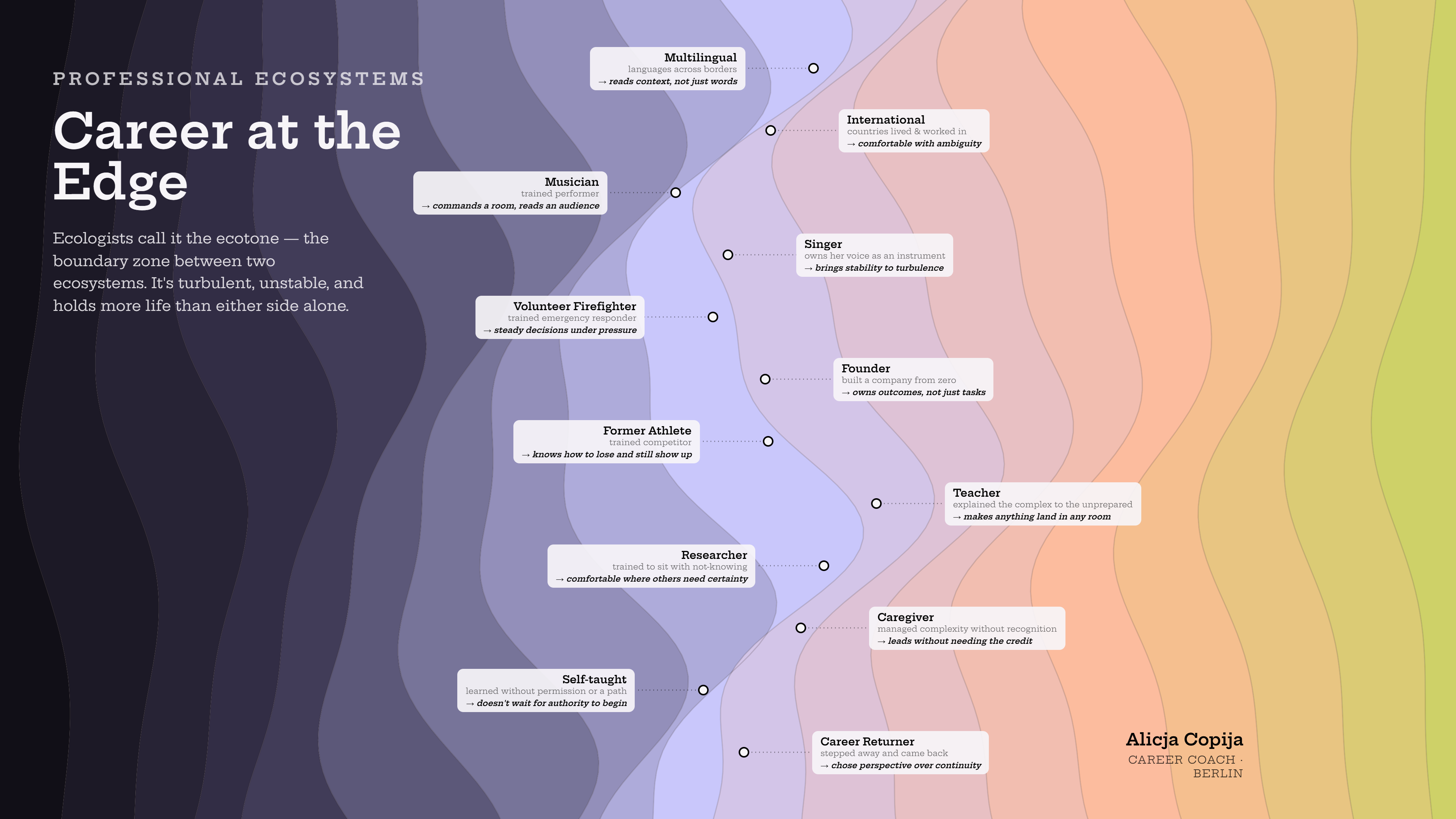
If your CV tells a straight story, same sector, steady progression, logical next steps at every turn, you can probably skip this one.
But if your background involves a detour, a pivot, a gap, a country change, or a function shift that made complete sense to you at the time and somehow still needs explaining ten years later, keep reading.
Because what most hiring managers call “non-traditional,” and what you have probably learned to apologise for, is often the most valuable thing you bring to a room.
The edge effect: what ecology can teach us about career paths
When I was a kid I spent a lot of time watching nature documentaries. To this day Sir David Attenborough is one of my most beloved public figures. Imagine the thrill I felt learning about the edge effect, which in ecology describes what happens where two different ecosystems such as forest and grassland or river and land, meet. The boundary zone between them is more biodiverse, more productive, and more complex than either ecosystem on its own. Species from both sides live there. Some species can only exist at that edge.
For me this maps onto non-linear careers and provides a lens that can change the way you look at your own path.
What if you looked at the times when you crossed a professional “boundary” by having changed roles or industries, moving countries, shifted function, stepping sideways into something new, and seeing it as your edge? Not as a loss of specialisation, but as the acquisition of a new ecosystem of knowledge and skills? Having that experience exposed you to new unwritten rules, new vocabulary, new patterns, and the shortcuts of multiple worlds.
Why do we so often see that as a gap?
What non-linear professionals actually offer
The person who moved from engineering into product management and then into a consulting role does not necessairly have a scattered background. They have a diverse understanding of how technical decisions become business decisions, become delivery problems and back again. They can see the whole loop. Something people inside any one of those functions often cannot.
The same is true of the international professionals in Germany who built their career across two or three countries before landing here. They hold the cultural logic of where they came from and the operational reality of where they are now. They had to become conscious of things that local professionals do completely automatically, which means they can see and articulate things that are invisible to people who have never had to examine them.
That is why companies that want to build products with global reach prioritise bringing different perspectives into the room. People who have navigated different systems, industries, and countries tend to produce solutions that travel further.
Why it feels like weakness instead of strength
The hiring market historically rewarded linear depth because linear depth is easy to evaluate. “Ten years in X” is a simple signal. A career that moves across contexts requires interpretation, and interpretation takes effort that many hiring managers do not invest.
So non-linear professionals learn to apologise for their path. They get asked “why did you leave?” as if leaving were an error. They frame transitions defensively. Over time, the market’s preference becomes internalised as a personal flaw.
I have been in hiring rooms for fifteen years. I have screened thousands of applications and made over a thousand hiring decisions, many of them about international candidates. I can tell you this: the most interesting profiles I have ever seen were rarely the linear ones.
My favourite honourable mentions: former lawyer turned Scrum Master, a policeman who moved into career advisory, a pharmacist who decided to change career towards data engineering, a recruiter who retrained as a pilates instructor, a fitness trainer who found their way into SaaS sales, a primary education teacher turned relationships coach.
Reading that can sound random, they all have done something unexpected in their careers. The one thing they had in common aside to having had crossed a boundary and coming back with a different perspective, is that they were able to articulate the leverage their diverse background gave them.
Where the real edge sits
Professionals with non-linear careers can be significantly stronger at three things that straight-line careers underdevelop.
Translation
They can move between disciplines or cultures and explain each to the other. In any role that sits at a crossroads between technical and commercial, between a local market and global headquarters, between a product team and its customers, this is a real asset. Sometimes it is the whole job.
Pattern recognition across contexts
Someone who has only ever worked in SaaS startups has a mental model shaped entirely by SaaS startup dynamics. Someone who has moved through different sectors has a richer understanding of how organisations behave under pressure, what good leadership can look like when you strip away sector-specific assumptions, and what always goes wrong regardless of context.
Comfort with reinvention
Non-linear professionals have already proven they can enter a new environment from zero and build credibility. Many people have never tested that capability because they have never had to. The ones who have and survived carry a fundamentally different relationship with uncertainty. The age of AI is forcing us into this reality whether we like it or not.
Framing is key: These are not (only) soft skills. Owning the narrative and positioning them as structural advantages that show up repeatedly in senior and cross-functional roles is the work that turns your edge into leverage.
The edges worth knowing about
The non-linear career is not the only edge worth knowing about. Here are the edges that come up most often in my work with international professionals in Germany.
The cultural edge
Holding the logic of where you came from and the operational reality of where you are now. You understand both the unwritten rules of your home context and the German professional culture. That translation capability is one that monoculture teams cannot easily build internally, and increasingly cannot afford to be without.
The language edge
Working professionally in a second or third language is consistently underestimated as an advantage. The cognitive distance forces more deliberate processing. People operating in a non-native language tend to make more considered, less reactive decisions.
The sector edge
Startup to corporate, or the reverse. Someone who has operated at both scales understands how decisions get made when resources are unlimited versus when they are not, when process exists versus when you are inventing it. That dual fluency is rare, and in a scaleup environment it is exactly what is needed.
The hierarchy edge
Having been both an individual contributor and a manager means you hold both perspectives. You understand what decisions look like from the top and what they feel like from below. Pure managers and pure ICs rarely develop that dual view without being forced to.
The founder edge
Someone who built something and then joined an organisation carries a different relationship with ownership, ambiguity, and institutional logic. Equally, someone who left stability to build something and came back carries proof of appetite that most CVs cannot demonstrate at all.
The disruption edge
Not every edge is chosen. Some people crossed into something new because their industry was disrupted and staying was not an option. Print, traditional retail, automotive. They did not choose the edge. The edge found them and they navigated it.
The common thread across all of these is the same: a boundary was crossed, knowledge was acquired on both sides, and something was built that would not exist without the crossing. The question is whether you can see it, name it, and bring it into the room.
What this means for your job search in Germany specifically
Germany’s hiring market is conservative in its signals. It values credentials, tenure, and recognisable trajectories. This is the environment where a non-linear career may feel uncomfortable, and where telling your story well matters most.
The work is not about explaining away your unusual path. It is about making the value of that path legible to someone who has been trained to look for something simpler.
That starts with a question that most people never ask themselves honestly: what can I do, see, or translate because of this path that a straight-line professional in my field cannot?
Once that question has a real answer, the CV summary, the interview response, and the salary conversation all shift. You stop trying to make a complicated story sound acceptable. You start making a rare story readable.
That is the work we do inside the coaching sessions, identifying what is actually in your professional story, making it visible, and positioning it for the context you are moving into.
Ready to see what your path has actually built?
Hi, I am Alicja. I am a career coach in Berlin, and I help international professionals navigate the German market. After fifteen years making hiring decisions on the other side of the table, I now work with people one to one on getting clear, getting seen, and getting past the fear that they have to prove themselves just a little bit more.