 Alicja
How to Read Your Interviewer: The 5 Types You'll Meet
TLDR: Most interview advice is about your answers. After 15 years in hiring rooms, I can tell you the people across the table matter just as much. Most of them were never trained to interview, which means structure and calm hand you more control than you expect. You will meet five recurring types: the Gatekeeper testing your nerve with abstract puzzles, the Diplomat probing your judgement through your own history, the Specialist drilling into how you actually work, the Distracted one who is elsewhere and not a verdict on you, and the Rockstar who wants to know you get it and won’t slow them down. Learn to read which one you’re facing, and you stop performing and start steering. And remember: how the panel behaves is a live preview of the team you’d be joining.
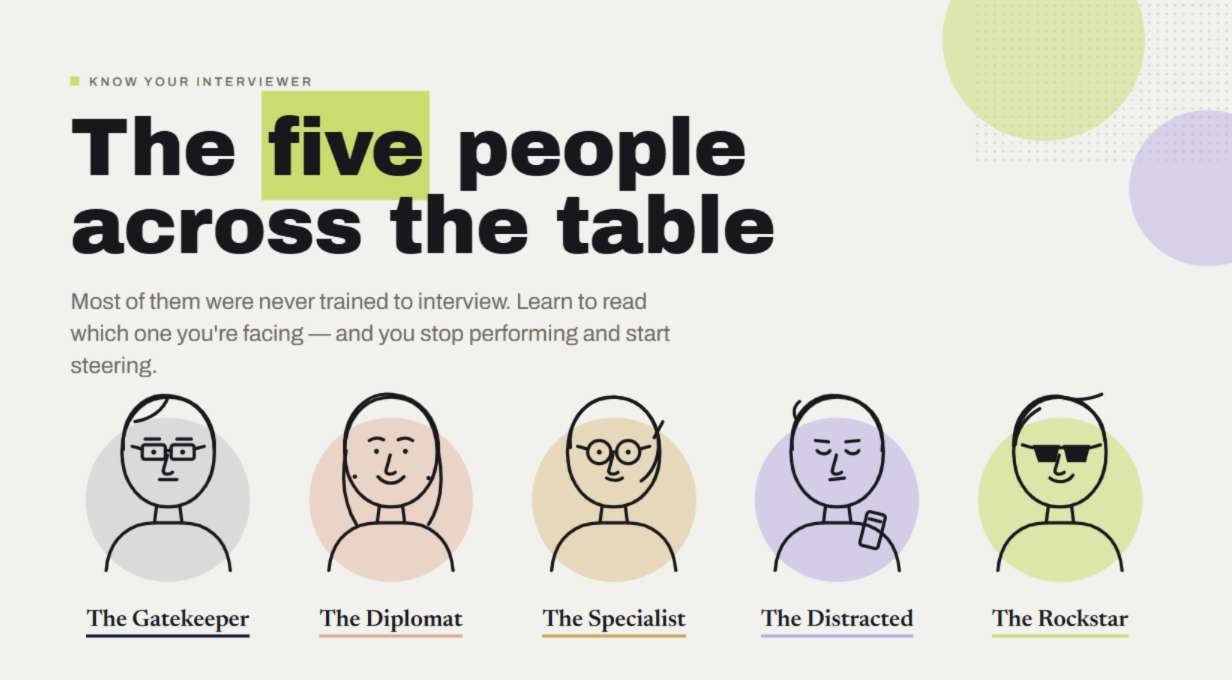
One of the most important things when planning to nail your interview is coming prepared, well researched about the company but also very clear about your own Unique Value Proposition in the context of the role you are interviewing for. This is where deep coaching work can help surface the right angles and arguments to use later in the room. But regardless of how well prepared you come, you are never the sole reason an interview goes well or badly. Much of it depends on the people you meet.
The Uncomfortable Truth No One Says Out Loud
Most people you meet during your interviews were never trained to interview. That includes (unfortunately) also HR professionals, though for the sake of making this piece tangible I will focus on everyone besides HR.
Whether you are meeting your future team, sitting a technical round, or working through a case study, it helps to remember that people usually learned to interview by jumping in and doing it, often with no guidance and sometimes with no clear idea of what they are supposed to be looking for. For a lot of them the situation is as uncomfortable as it is for you. While (almost) all of them are trying their best, trying their best does not make them 100% accurate.
So remember: interviews feel improvised because … they often are. At some companies weeks pass between one hiring round and the next, so the person across from you may be rusty or working it out as they go. So if you walk in with structure and a clear, confident narrative, you gain far more control over that room than you thought you could.
The 5 Types of Interviewers You’ll Meet
There is always someone whose role (usually self-appointed), is quality control, delivered with a quiet “you shall not pass” energy. You feel it immediately. They treat the interview as a one-way street, a survival test rather than a conversation. I have watched junior interviewers, seniors, and leads all take on this role. In my view it is often a mask for their own insecurity, where the effort to look professional turns into performance toughness and hardens into biased opinion. A junior might ask overcomplicated questions to seem more senior. A senior might hunt for the one and only acceptable answer.
What sets the Gatekeeper apart is that their questions are rarely about you. They are abstract on purpose. How many ping-pong balls fit in an airplane. How would you size the orange juice market in Munich. How would you explain software architecture to someone with no technical background. None of these has an answer sitting in your CV. They are built to watch how you reason under pressure, how you handle ambiguity, and whether you crack when there is nothing solid to hold onto.
I have sat next to one on a panel and watched a strong candidate shrink into one-word answers because every sentence was graded before they finished it. The move is not to land the perfect number. It is to stay composed and think out loud, so the panel sees a mind working rather than a person freezing. Treat each question as a window to show your reasoning, not a trap with a single correct exit. And here is the counter-intuitive part: Gatekeepers soften when you make an interesting attempt and then take the correction without getting defensive. Composure under challenge is the whole test.
What they’re really asking: Is this person smart enough, and will they hold their nerve?
The risk in the debrief: Their contribution lands mostly on the negative side. It usually starts with “My concern is…”
What shifts the outcome: You cannot prepare the content of a brainteaser 🧠, so prepare the behaviour instead. Slow down. Use pauses instead of rushing to fill them. Narrate your structure before your answer. A wrong number reached through clear reasoning beats a lucky guess with none.
When you meet a Diplomat, take it as a good sign. Their presence usually means something about the team actually works. They have solid interpersonal skills, which makes the conversation flow easily. Do not be lulled by that ease. The Diplomat is often the hiring manager’s most trusted voice in the debrief, so winning them over matters more than their warmth suggests.
Where the Gatekeeper stays abstract, the Diplomat gets personal. Their questions only work because they are about you and how you have actually behaved with real people. Walk me through a decision you later regretted. Tell me about a disagreement with a manager and what your part in it was. They are working out whether you are safe to put in front of a client, a team, or important stakehodlers.
What they’re really asking: Can I trust your judgement?
The risk in the debrief: They carry high trust with the hiring manager. A thumbs-up from the Diplomat often outweighs approval from anyone else on the panel.
What shifts the outcome: Come with your stories already prepared. You do not need twenty separate stories. Think about them in themes 💡
There are only about eight themes an interviewer is really testing: leadership, teamwork, conflict, problem solving, failure and what you learned, initiative, adaptability, communication.
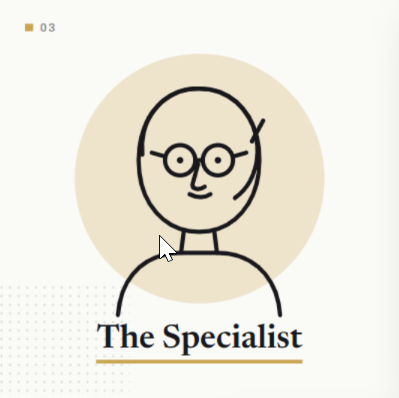
The Specialist can be the hardest to warm up. They can skip the small talk and go straight to the substance, no easing in. Do not read the missing pleasantries as hostility. This is usually the person who carries the real work of the team, and they want to get to the point not to add to their load.
Their signature is a real problem, handed to you in the present tense. Here is something we are actually dealing with. How would you approach it? What would you check first? Where would this break? They keep going, one layer down and another, until they can see how far your understanding actually goes. Where the Gatekeeper’s puzzle is abstract and consequence-free, the Specialist’s problem is real and they want to watch you think through it in front of them.
Reason out loud. Say what you would check, what you are unsure of, what you would rule out and why. The moment you expose the messy middle instead of presenting a tidy conclusion, the interview quietly turns into a conversation between peers.
What they’re really asking: Will this person actually make my work easier?
The risk in the debrief: The danger with the Specialist is coming across as extra work. If your answers are vague or float at the level of theory, they assume they will end up re-teaching you or redoing what you deliver.
What shifts the outcome: Follow their questions down as far as they go, and stay structured while you do it. Do not tidy the answer into a headline. They are looking for concrete evidence that you will be reliable.
After months of applications, sitting across from someone who is visibly elsewhere can be demoralising. Hold onto this: it has nothing to do with you, and you have no way of knowing what is pulling their attention. If other people are on the panel, put your energy there.
The Distracted one barely has a signature question, and that is the signature. The questions are flat, generic, or already answered on your CV, asked with no real follow-up. Nine times out of ten they are putting out a fire somewhere else or still turning over a problem from that morning, so their low energy is not a verdict on you. That said, let me be honest about what it can signal. A senior person who cannot give thirty minutes of focus to a potential future colleague or direct report is not simply busy. To me it points to poor team dynamics and a culture stuck in permanent reaction mode.
What they’re really asking: Sorry, what were you saying?
What shifts the outcome: Do not overinvest in winning them back, and do not rush to fill the flatness. Answer slowly and clearly, stay professional, and move your energy to whoever is engaged. If the whole panel is glancing at second screens, pay attention: you are not looking at a team you want to join, you are looking at a building on fire.
From a hiring perspective, this one is a nightmare, though management does not always see it that way. You recognise the Rockstar by sheer self-confidence carrying an unsettling edge of rudeness. They are the Dr. House of the team, the untouchable expert who is so good at solving the impossible problems that leadership has quietly granted them a licence to be difficult, and in most cases has no idea about the second half of that sentence.
Rockstars are often right that it convinces them they read everything else accurately too, including how they come across to people. So the difficulty is rarely a deliberate power play.
This is a well-documented problem for organizations. Netflix built part of its culture on refusing to keep brilliant people who are hard on everyone around them, on the logic that the damage to the team outweighs the output. Sadly, many companies are not that disciplined. They keep the Rockstar, build the team to work around them, and absorb the cost. Which is exactly why you might be put in front of one. Your interview is partly a stress test: the team already knows this person is difficult, and they want to see whether you will can deal with that person.
Sometimes ROckstars dismiss your answer and give you their own, because they simply believe their way is right. And sometimes what they are really after is to hear their own opinion come back to them in someone else’s voice. So the play is the opposite of trying to match them. Show you are willing to learn from them and help close a gap they already feel, even if they would never name it. They welcome real depth in an area next to their own, and a measure of considered pushback, because a pure yes-person bores them and they would rather work alone.
What they’re really asking: Do you get it, or will you slow me down
The risk in the debrief: If they decide you do not get it, they find a reason to say no. If they feel recognised and useful, they become one of your strongest advocates. .
What shifts the outcome: Do not compete, and do not defend. When they counter your answer with the one they were fishing for, resist the urge to explain why you chose differently. Defending signals you think they are wrong, and being corrected back by someone who has already filed you as junior is what sinks you. Drop the “but” and reach for “and.” Something like: “I see what you were looking for, and the way I see it there is usually more than one way to solve this. When I work with a team, I tend to…” then show your route as a second valid path, not a correction of theirs. And read the room around them. If a whole team is quietly built to route around one person, that is not a quirk. It is the company telling you it tolerates output over collaboration. Use that information.
Beyond the Personas: What to Do No Matter Who’s Across the Table
Research the room before you walk in. If you were not given names, ask the recruiter or coordinator for them. Then look each person up. How long have they been at the company, what is their role, have they written or spoken about anything recently. Ten minutes of this shifts the power dynamic more than an hour of rehearsing answers, because you stop walking into a room of strangers.
Mind the timing. Where you have any say over scheduling, avoid the depleted slots. The interview right before lunch and the last one on Friday both meet a panel running low. If you can avoid such schedules.
Make it a conversation. A goof rule of thumb is to speak 50% of the time whole allowing for 50% contribution from whomever you speak with. Make sure to avoid closed questions or answers and think about your answers being 20 sec. - 2 min long.
Turn the thank-you note into a connection. After the interview, send your follow-up as a LinkedIn connection request to the people you met, with a short, specific line about the conversation. Even when the role does not land, you have added relevant people to your network. For international professionals in Germany, where a thin local network is one of the real structural disadvantages, this quietly compounds over time.
Match the register of the room. Self-presentation is cultural, and the German market rewards a quieter, more precise kind of confidence than some others. Read the formality of the people in front of you and meet it. Overselling reads as noise here, and underselling leaves your competence invisible. The skill is calibration.
Remember you are interviewing them too. Every persona you meet is a live sample of the team you would join. The Gatekeeper’s contempt, the Rockstar everyone tiptoes around, these are not interview quirks. They are your future Tuesdays. Watch them as carefully as they watch you.
The Takeaway
There is no perfect interview process, because there are no perfect people running one. The characters you meet are a direct sample of the team you would be joining, so pay attention. They are showing you your future daily life. And read the chemistry in the room. If the panel already feels like a battle, the job will feel like a war.
Reading the room is a skill, and like any skill it can be built. If you want to walk into your next interview able to read who is across the table and tell a career story that lands with the people who decide, that is the work I do inside Visibility Reset.
Hi, I am Alicja. I am a career coach in Berlin, and I help international professionals navigate the German market. After fifteen years making hiring decisions on the other side of the table, I now work with people one to one on getting clear, getting seen, and getting past the fear that they have to prove themselves just a little bit more.